
The Science of Better Leadership: How FLIGBY Develops Emotional Intelligence
1. Emotional Intelligence: The Human Side of Leadership
1.1 Goleman’s Original Idea
For decades, leadership success was primarily associated with intelligence, expertise, and technical competence. While these qualities remain important, modern organizations increasingly recognize that outstanding leaders distinguish themselves beyond what they know by how they understand themselves, relate to others, and navigate complex interpersonal situations. These capabilities are collectively known as Emotional Intelligence (EI).
The concept gained worldwide recognition through psychologist Daniel Goleman, whose groundbreaking 1995 book Emotional Intelligence argued that emotional competencies can be as important as cognitive intelligence for professional and personal success. Goleman later adapted the framework for leadership, identifying five interconnected dimensions of Emotional Intelligence:
- Self-awareness – Recognizing one’s own emotions, strengths, limitations, and their impact on others.
- Self-regulation – Managing emotions constructively, particularly under pressure.
- Motivation – maintaining internal drive, resilience, and commitment toward meaningful goals.
- Empathy – Understanding the emotions and perspectives of others.
- Social skills – Building relationships, communicating effectively, and influencing people toward shared objectives.
Together, these competencies enable leaders to make better decisions, resolve conflicts, build trust, and inspire high-performing teams.
1.2 Why Emotional Intelligence Matters More Than Ever
Decision-makers in the 21st century operate in environments marked by uncertainty, rapid change, hybrid workforces, and growing organizational complexity. In these settings, technical expertise alone is rarely sufficient. Every important decision affects not only business outcomes but also people’s motivation, engagement, collaboration, and willingness to contribute.
A growing body of research underscores the importance of Emotional Intelligence for effective leadership. The World Economic Forum’s Future of Jobs Report 2025 identifies resilience, flexibility, leadership, social influence, empathy, active listening, and curiosity as among the most rapidly growing workplace skills demanded by employers worldwide. These capabilities closely align with the core components of Emotional Intelligence.
Similarly, research by TalentSmartEQ, based on assessments of more than one million professionals, found that Emotional Intelligence is the strongest predictor of workplace performance, accounting for approximately 58% of success across job types. The same research also reported that about 90% of top performers score highly in Emotional Intelligence, underscoring its strong link to exceptional leadership performance.
Academic research supports these observations as well. A comprehensive meta-analysis by Miao, Humphrey, and Qian (2017), which synthesized results from dozens of independent studies, found consistent positive relationships between leaders’ Emotional Intelligence and transformational leadership, employee job satisfaction, organizational commitment, and overall job performance. Rather than being merely a desirable personality trait, Emotional Intelligence emerges as a measurable contributor to organizational effectiveness.
In other words, leaders are increasingly evaluated on how they make decisions and how those decisions affect the people around them.
2. From Emotional Intelligence to Good Business
2.1 Beyond a Personal Attitude
Emotional Intelligence is often described as a personal competency, a set of abilities that helps leaders understand themselves, relate to others, and navigate interpersonal situations effectively. While this is true, it only tells part of the story. The real value of Emotional Intelligence lies not in the competencies themselves but in what they enable leaders to create within their organizations.
Leadership is fundamentally about shaping the environment in which people work. Every conversation, decision, piece of feedback, and response to success or failure sends a message that shapes how people think, feel, and perform. Over time, these seemingly small interactions define a team’s culture.
This is where Emotional Intelligence becomes a strategic business capability rather than merely a personal attribute.
2.2 Emotional Intelligence Shapes Leadership Behaviors
Daniel Goleman’s five dimensions of Emotional Intelligence translate into observable leadership behaviors that employees encounter every day. Emotionally intelligent leaders are more likely to:
- Communicate with clarity and respect;
- Remain composed during uncertainty and conflict;
- Listen before making decisions;
- Recognize the unique motivations and strengths of individual team members;
- Provide constructive feedback rather than criticism;
- Build trust through consistency and authenticity.
These behaviors influence far more than workplace relationships. They determine whether employees feel confident enough to contribute ideas, comfortable enough to admit mistakes, motivated to tackle difficult challenges, and committed to shared goals. In other words, Emotional Intelligence shapes an organization’s emotional climate.
2.3 Leadership Creates the Conditions for Flow
Professor Mihaly Csikszentmihalyi’s research showed that people perform best when they experience Flow: a state of deep engagement in which attention is fully focused, challenges match individual capabilities, goals are clear, and feedback is immediate. Although Flow is experienced by individuals, the conditions that make it possible are often created (or destroyed) by leaders.
A manager who sets clear expectations, delegates meaningful responsibility, fosters open communication, and responds constructively to mistakes lays the foundation for Flow. Conversely, inconsistent communication, excessive control, unclear priorities, or emotionally reactive leadership can quickly undermine engagement and creativity.
From this perspective, Emotional Intelligence becomes one of the primary enablers of Flow.
The relationship becomes even clearer when we compare the essential conditions of Flow with the leadership behaviors needed to establish them.
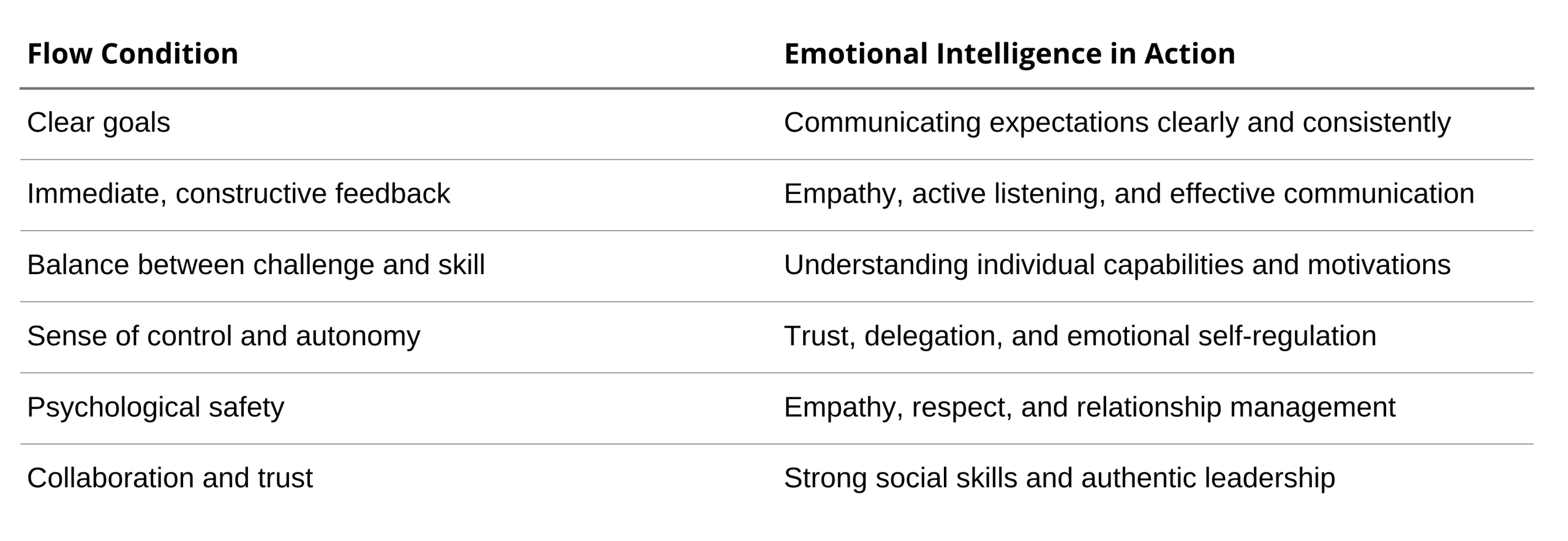
The table highlights an important insight: Flow is not created by organizational processes alone. It is largely enabled by emotionally intelligent leadership.
2.4 From Flow to Good Business
Csikszentmihalyi expanded on this idea in his later work, Good Business. He argued that organizations achieve sustainable success not by maximizing short-term results at the expense of people, but by creating environments where employees can consistently perform at their highest potential and find meaning and satisfaction in their work.
This perspective challenges the traditional assumption that employee well-being and business performance compete with one another. Instead, they reinforce each other.
When leaders cultivate trust, encourage autonomy, recognize achievements, and maintain open communication, employees become more engaged. Engaged employees collaborate more effectively, solve problems more creatively, adapt more quickly to change, and build stronger relationships with both customers and colleagues.
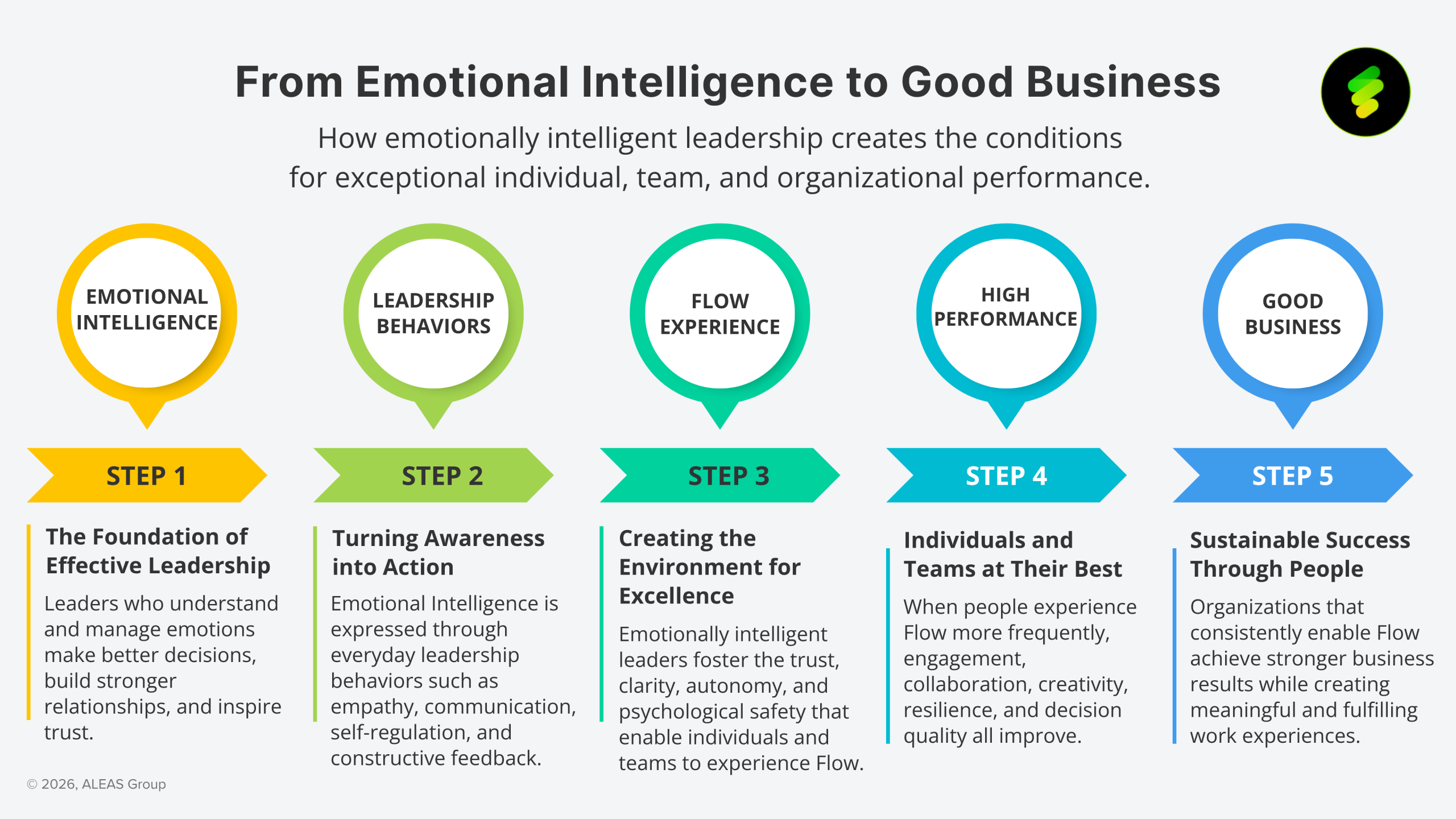
This chain captures the essence of Csikszentmihalyi’s philosophy. Business excellence is not achieved despite caring about people; it is achieved because organizations create the conditions in which people can thrive.
2.5 Why This Matters for Leadership Development
If Good Business depends on emotionally intelligent leadership, an important question follows: How can leaders develop these capabilities?
Reading about Emotional Intelligence provides valuable knowledge, but leadership is ultimately a behavioral discipline: self-awareness, empathy, conflict management, and relationship building are learned through experience, reflection, and practice, not theory alone.
This is precisely the challenge FLIGBY was designed to address.
Rather than asking participants how they think they would behave, FLIGBY places them in realistic leadership situations where every decision affects people, team dynamics, and business outcomes. By experiencing the consequences of their choices and reflecting on detailed behavioral feedback (including the quantification of Emotional Intelligence as a measurable skill), participants develop practical leadership habits that link Emotional Intelligence to Flow and, ultimately, to Good Business.
3. Five Essential Lessons FLIGBY Teaches About Emotional Intelligence
3.1 Emotional Intelligence in Action
Understanding Emotional Intelligence is one thing. Applying it during a difficult conversation, an unexpected crisis, or a complex business decision is something entirely different.
This distinction explains why Emotional Intelligence cannot be developed through theory alone. FLIGBY was designed around this principle. Throughout the interactive simulation, players step into the role of a newly appointed general manager at a prestigious California winery. They are challenged to make dozens of leadership decisions involving employees, customers, business partners, and owners, each with distinct personalities, motivations, and expectations.
Unlike traditional training, there are rarely perfect choices. Players must balance business objectives with human needs, often under uncertainty and time pressure. As the story progresses, consequences unfold naturally, allowing participants to experience how emotionally intelligent leadership (or its absence) shapes both organizational performance and the well-being of those around them.
Throughout this journey, five essential lessons become clear.
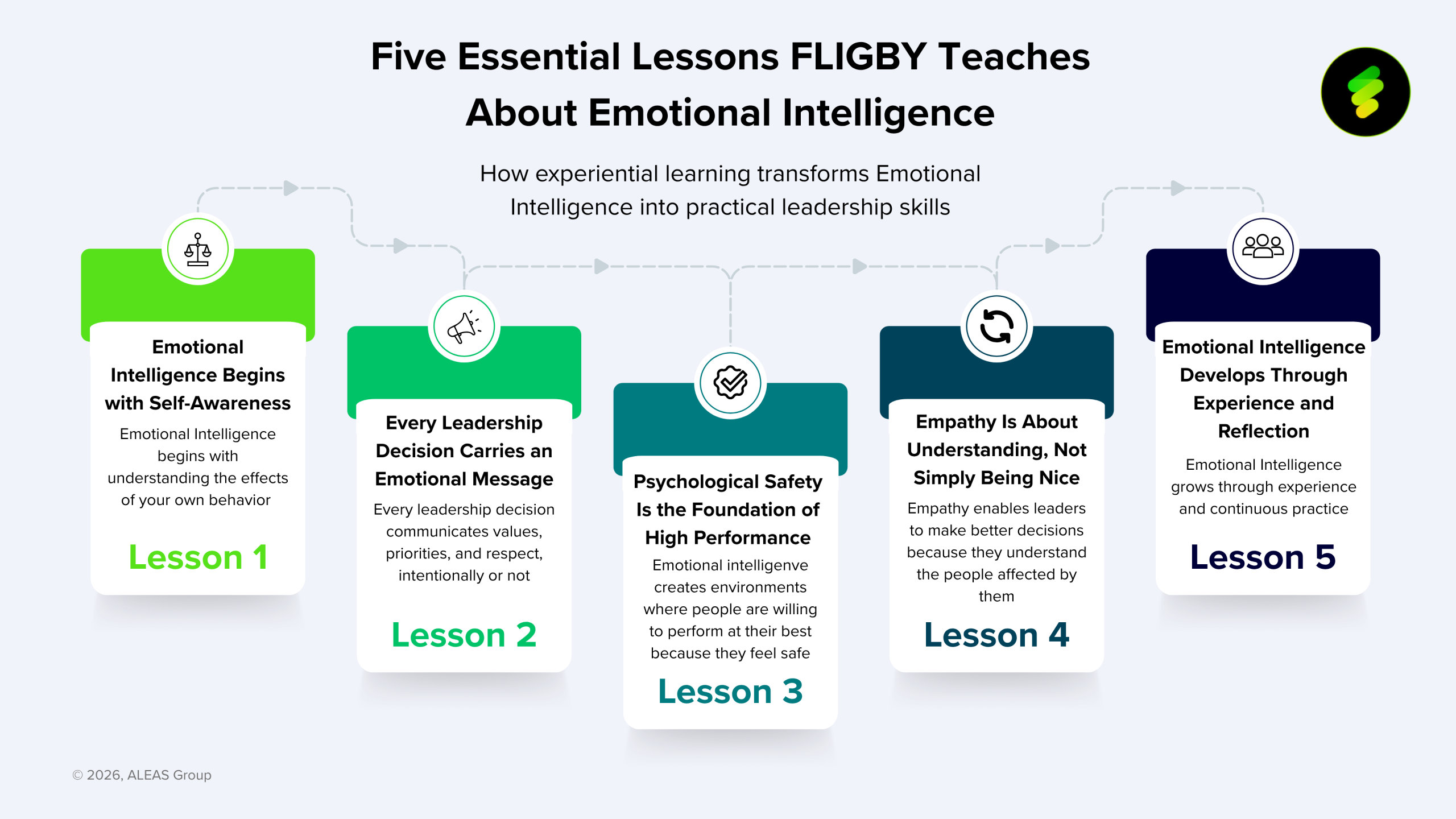
Lesson 1: Emotional Intelligence Begins with Self-Awareness
The first lesson is perhaps the most fundamental: leaders do not always see themselves as others do.
Many participants begin FLIGBY believing they are supportive communicators, effective motivators, or good listeners. Yet as the story unfolds, they discover that decisions made with good intentions can produce unexpected reactions among employees.
A delayed conversation may be interpreted as indifference. A well-intentioned intervention may reduce a team member’s sense of autonomy. A quick business decision may unintentionally weaken trust. This gap between intention and impact is one of the most valuable learning moments in the simulation.
FLIGBY helps players recognize these patterns through detailed behavioral feedback and the Leadership Skills Profile, turning individual decisions into meaningful self-reflection.
Key insight: Emotional Intelligence begins with understanding the effects of your own behavior before attempting to influence others.
Lesson 2: Every Leadership Decision Carries an Emotional Message
Leaders often think they communicate through meetings, presentations, or formal feedback. In reality, they communicate through every decision they make. Whether assigning responsibilities, resolving disagreements, responding to mistakes, or recognizing achievements, each action sends signals that employees interpret emotionally.
People constantly ask themselves:
- Can I trust my manager?
- Is my opinion valued?
- Is it safe to speak honestly?
- Will my efforts be recognized?
- Am I being supported or controlled?
FLIGBY demonstrates that leadership decisions are never purely operational. They shape relationships, influence motivation, and gradually define organizational culture. The simulation repeatedly shows that employees respond not only to what leaders decide but also to how those decisions are made.
Key insight: Every leadership decision communicates values, priorities, and respect, intentionally or not.
Lesson 3: Psychological Safety Is the Foundation of High Performance
One of the strongest messages throughout FLIGBY is that exceptional performance cannot be sustained by authority or pressure alone. The most successful teams are those where people feel confident enough to contribute ideas, admit mistakes, challenge assumptions, and collaborate openly. Today, this environment is widely known as psychological safety, and it is also an essential prerequisite for achieving Flow.
As players navigate the complex relationships within the winery, they repeatedly encounter situations in which trust either grows or deteriorates based on their leadership choices.
Encouraging open dialogue, responding constructively to setbacks, involving employees in decision-making, and recognizing contributions all strengthen psychological safety. Conversely, dismissing concerns, overreacting to mistakes, or controlling every detail quickly erode engagement.
Players experience firsthand that organizational performance is closely tied to how people feel about contributing to the team.
Key insight: Emotionally intelligent leaders create environments where people are willing to perform at their best because they feel safe enough to do so.
Lesson 4: Empathy Is About Understanding, Not Simply Being Nice
Empathy is sometimes misunderstood as avoiding difficult conversations or trying to make everyone happy. FLIGBY offers a more practical definition. Effective leaders seek to understand what different individuals need to succeed. One employee may need greater autonomy, another may benefit from coaching and encouragement, and someone else may require direct feedback or clearer expectations. Treating everyone identically may seem fair, but it rarely leads to the best outcomes.
The simulation challenges players to recognize these differences and adapt their leadership approach accordingly. Success depends on understanding perspectives, motivations, and emotional responses, not on avoiding difficult decisions.
In this sense, empathy becomes an essential decision-making capability rather than merely an interpersonal virtue.
Key insight: Empathy enables leaders to make better decisions because they understand the people affected by them.
Lesson 5: Emotional Intelligence Develops Through Experience and Reflection
Perhaps the most important lesson of all is that Emotional Intelligence is not a fixed personality trait. It is a capability that can be developed. Every scenario in FLIGBY creates a learning cycle: Players make decisions, observe the consequences, receive detailed behavioral feedback, reflect on what happened, and then replay situations with new insights and different strategies.
This mirrors the principles of experiential learning and deliberate practice. Rather than memorizing leadership theories, participants improve through repeated cycles of action and reflection.
Over time, emotionally intelligent behaviors become increasingly natural because players have experienced (not merely studied) their effects. This is why FLIGBY goes beyond assessment. It serves as a safe environment for practicing leadership before those decisions affect real employees and real organizations.
Key insight: Emotional Intelligence grows through experience, feedback, reflection, and continuous practice.
4. Closing Thoughts: Emotional Intelligence Is Measured by Decisions, Not Intentions
Emotional Intelligence has become one of the defining leadership capabilities of our time. Yet despite its growing importance, many leadership development programs still treat it primarily as knowledge to be acquired or as a personality trait to be assessed.
Leadership, however, is demonstrated through decisions.
Every day, leaders choose how to communicate, respond to setbacks, balance business priorities with human needs, resolve conflicts, and inspire others to contribute their best. These decisions shape trust, influence motivation, determine whether people feel psychologically safe, and ultimately determine whether teams merely function or truly flourish.
This is why Emotional Intelligence cannot be separated from experience. It develops through action, reflection, feedback, and a willingness to continuously improve.
That philosophy lies at the heart of FLIGBY. Inspired by Professor Mihaly Csikszentmihalyi’s vision of Flow and Good Business, FLIGBY provides leaders with a safe environment to practice the decisions that define emotionally intelligent leadership. Rather than simply evaluating personality or teaching management concepts, it immerses participants in realistic business situations in which every choice carries both human and organizational consequences.
The result is more than greater self-awareness. It is a deeper understanding of how leadership behaviors influence engagement, collaboration, trust, and performance—and how these seemingly small interactions accumulate to shape organizational culture.
In the end, Emotional Intelligence is not about becoming someone else. It is about becoming a more conscious leader.
By Zsadany ZAD Vecsey, CEO, ALEAS Group
Selected References
- Csikszentmihalyi, M. (1990). Flow: The Psychology of Optimal Experience. Harper & Row.
- Csikszentmihalyi, M. (2003). Good Business: Leadership, Flow, and the Making of Meaning. Viking.
- Goleman, D. (1995). Emotional Intelligence: Why It Can Matter More Than IQ. Bantam Books.
- Goleman, D. (1998). Working with Emotional Intelligence. Bantam Books.
- Goleman, D. (2000). Leadership That Gets Results. Harvard Business Review, 78(2), 78–90.
- Miao, C., Humphrey, R. H., & Qian, S. (2017). “A Meta-Analysis of Emotional Intelligence and Work Attitudes.” Journal of Occupational and Organizational Psychology, 90(2), 177–202.
- TalentSmartEQ. (2024). The Business Case for Emotional Intelligence. https://www.talentsmarteq.com
- World Economic Forum. (2025). The Future of Jobs Report 2025. https://www.weforum.org/reports/the-future-of-jobs-report-2025
- Kolb, D. A. (2015). Experiential Learning: Experience as the Source of Learning and Development (2nd ed.). Pearson Education.