Workforce Skills 2030: Are We Teaching What Really Matters?
Rethinking Leadership Development for 2030
The future of work is not waiting for higher education to catch up—it is already reshaping what it means to be prepared, capable, and employable. According to the World Economic Forum, nearly 40% of core workforce skills will change by 2030. Yet the shift is not simply about acquiring new technical knowledge. Employers increasingly prioritize graduates who can navigate ambiguity, think critically, collaborate effectively, and lead with confidence in complex, fast-changing environments.
This transformation brings a fundamental question into focus for universities and educators alike: are we truly equipping students with the competencies that matter most—or are we still optimizing for what is easiest to measure?
One compelling way to explore this gap is to compare the World Economic Forum’s future skills framework with the 29 leadership competencies assessed by FLIGBY—an immersive simulation grounded in Mihaly Csikszentmihalyi’s concept of Flow. This comparison offers both reassurance and a challenge: while there is significant alignment between what the future demands and what FLIGBY measures, it also underscores the growing importance of experiential, decision-based learning for developing these skills effectively.
In this article, we examine where these frameworks intersect, where gaps remain, and what this means for the future of leadership development in higher education. As part of this conversation, we invite educators to engage more deeply with these ideas through FLIGBY’s Live Academic Webinar Series—designed to bring theory to life and help institutions rethink how leadership competencies are taught, measured, and experienced.
Skills Are Evolving, Not Disappearing
The conversation about the future of work is often framed in extremes—automation versus human relevance, technology versus people. But the reality, as emphasized by the World Economic Forum, is far more nuanced. Knowledge itself is not losing value; rather, the conditions under which it becomes useful are shifting fundamentally.
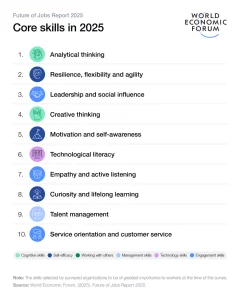
In this new landscape, having information is no longer enough. What matters is the ability to interpret, apply, and adapt that knowledge in dynamic, often unpredictable contexts. By 2030, the most critical skills identified by the WEF reflect this shift toward higher-order thinking and human-centered capabilities: analytical thinking, leadership and social influence, resilience and adaptability, creativity, curiosity, and emotional intelligence.
At the same time, a second layer of competencies is rapidly gaining importance. Skills related to AI and big data, technological literacy, cybersecurity, and environmental stewardship are no longer niche—they are becoming baseline expectations across industries.
This convergence creates a clear and compelling reality for higher education. The challenge is not to choose between human and technical skills but to integrate them. Graduates must be able to think critically, understand data, lead people, navigate technology, remain adaptable, and learn continuously.
The implication is unmistakable: future-ready professionals will be those who combine deeply human capabilities with strong technological awareness—and know how to apply both in real-world decision-making.
The FLIGBY Insight: What We Rarely Teach Explicitly
The World Economic Forum outlines a clear direction for the future of skills—but what does it look like to develop and measure those skills in practice? This is where FLIGBY offers a powerful, complementary perspective.
While the WEF defines which competencies will matter, FLIGBY focuses on how those competencies are demonstrated in real-world situations. Rather than testing knowledge, it captures behavior—how individuals think, decide, and interact under pressure, ambiguity, and complexity. Its 29 measured competencies—including decision-making under pressure, conflict management, stakeholder alignment, strategic thinking, and emotional intelligence—translate abstract “future skills” into observable actions.
Where WEF and FLIGBY Converge
1. From Knowledge to Applied Thinking
The future belongs to those who can apply knowledge, not merely acquire it.
The WEF emphasizes analytical thinking as the most critical skill for the future—underscoring the importance of using knowledge effectively rather than simply possessing it.
FLIGBY reflects this through competencies such as analytical skill, information gathering, prioritization, and time-sensitive decision-making. These skills are not tested in isolation but in dynamic scenarios where participants must interpret information and act on it.
2. Leadership as an Everyday Capability
Leadership is no longer optional—it is a core professional skill.
The WEF identifies leadership and social influence as essential across roles and industries—not as a specialization, but as a baseline expectation.
FLIGBY mirrors this by embedding leadership into every decision. Participants continuously practice delegation, empowerment, teamwork management, and stakeholder coordination—treating leadership as a daily responsibility rather than a distant goal.
3. The Rising Value of Human Skills
As technology advances, human skills become more—not less—valuable.
Despite rapid technological progress, the WEF places greater emphasis on human-centered skills such as emotional intelligence, empathy, and collaboration.
FLIGBY operationalizes these skills through measurable behaviors: active listening, social awareness, diplomacy, and engagement. Success in the simulation depends not only on outcomes but also on how decisions affect people and relationships.
What Universities Must Add
The Missing Layer
There is a critical layer where universities must take the lead: integrating technical and contextual knowledge into the development of the skills above. This includes AI and data literacy, understanding digital systems, cybersecurity awareness, and sustainability thinking. These competencies do not compete with human skills—they amplify them. They provide the context in which decision-making, leadership, and collaboration now take place.
A graduate who can lead but lacks technological understanding will quickly face limitations. At the same time, a graduate who understands technology but cannot lead, adapt, or collaborate will struggle to make an impact. The future does not reward either. It requires both working together.
The Real Challenge: Teaching What Is Hard to Measure
This leads to a more fundamental challenge for higher education: universities are highly effective at teaching what is easy to test. Yet the future demands skills that are inherently difficult to measure. Consider the competencies most critical in real-world environments: decision-making under uncertainty, managing conflict, balancing competing priorities, and motivating others. These skills cannot be fully developed through lectures or evaluated through standard exams.
This is where experiential learning becomes essential—and where tools like FLIGBY play a distinct role. By placing learners in complex, simulated environments, these tools make these “invisible” skills visible and measurable. Not as a replacement for academic education, but as a powerful complement to it.
The implication for universities is clear: to remain relevant, they must go beyond transmitting knowledge—and start creating environments where future-ready skills can be practiced, observed, and developed in action.
Implications for Curriculum Design
For university leaders and faculty, this is not just an interesting observation—it points to concrete changes in how curricula should be designed. If future skills are both human and technical, as well as cognitive and behavioral, then education must evolve accordingly.
Three actionable shifts stand out:
1. Moving from Knowledge-Centric to Skill-Integrated Learning
Traditional curricula often separate “what we teach” (content) from “what students should be able to do” (skills). In reality, these cannot be developed in isolation. Forward-looking programs are beginning to integrate the two by
- Teaching analytics through real-world decision-making scenarios
- Teaching strategy through simulation-based experiences
- Embedding problem-solving within subject-specific contexts
The goal is not to reduce academic rigor but to make knowledge usable—by placing it in situations where students must apply, test, and adapt what they know.
2. Embedding Leadership and Human Skills Across Disciplines
Leadership is still too often treated as a specialization, typically confined to business education. Yet the World Economic Forum makes it clear: leadership and social influence are core skills across professions. This has direct implications for curriculum design. Leadership and human skills should be embedded across disciplines—not added as optional extras.
Engineers, scientists, and data analysts all need:
- Communication
- Collaboration
- Stakeholder awareness
These are not “soft” skills; they are essential capabilities for functioning in complex, interdisciplinary environments.
3. Combining Human Skills with Technological Context
Perhaps the most important shift is the deliberate integration of human competencies with technological understanding. The most future-ready curricula will combine competencies such as decision-making, leadership, and interpersonal effectiveness with domains such as AI, sustainability, and digital systems. This integration ensures that students are not only capable of navigating technology but also of leading within it—making informed decisions, managing people, and creating value in increasingly complex systems.
Taken together, these shifts signal a broader transformation. Curriculum design is no longer just about structuring knowledge—it is about designing experiences that develop the full spectrum of future-ready capabilities.
The institutions that succeed will be those that move beyond teaching skills—and start building environments where those skills are continuously practiced and refined.
Final Thought: Universities as Capability Builders
The future of higher education will be defined not by how much knowledge graduates accumulate—but by what they can do with it. Success will belong to those who can think critically in unfamiliar situations, act decisively under pressure, adapt to constant change, and collaborate effectively across disciplines and cultures. These are not abstract ideals; they are the core capabilities that shape performance in the real world.
This means moving beyond curricula that primarily transfer knowledge toward learning experiences that actively develop capability. It also means creating environments where students are not only informed but challenged—where they must apply, reflect, and grow through action.
The institutions that will lead in the next decade are not those that simply teach more. They are the ones that build graduates who are ready to perform, adapt, and lead.
By Judit Nuszpl, Head of Program Development at FLIGBY
Q&A: Understanding Workforce Skills 2030 and the Role of Universities
Why are workforce skills changing so significantly by 2030?
Driven by rapid technological advancement, particularly AI and automation, as well as globalization and sustainability pressures, the nature of work is shifting. The World Economic Forum estimates that nearly 40% of core skills will change, meaning many roles will require new combinations of technical, cognitive, and human capabilities.
Does this mean technical skills are more important than human skills?
No. The trend is not a replacement of human skills but a rebalancing. While AI, data literacy, and digital systems knowledge are increasingly important, human skills such as leadership, emotional intelligence, and adaptability are becoming even more critical as technology scales, rather than eliminating them.
What are the most important skills for the future workforce?
According to the WEF framework, key future skills include analytical thinking, leadership and social influence, resilience, creativity, curiosity, and emotional intelligence—supported by technical competencies such as AI literacy, cybersecurity awareness, and sustainability thinking.
How does FLIGBY relate to these future skills?
FLIGBY measures how individuals behave in realistic, complex decision-making environments. It focuses on competencies such as leadership, conflict management, stakeholder alignment, strategic thinking, and emotional intelligence—making many of the WEF’s abstract skills observable and assessable in action.
What is the main gap in traditional university education?
Many universities are highly effective at teaching knowledge but less effective at developing applied skills—especially those requiring decision-making under uncertainty, navigating interpersonal dynamics, and making real-time judgments. These skills are difficult to measure through exams or lectures alone.
How can universities better prepare students for workforce skills in 2030?
By integrating knowledge with applied learning, embedding leadership and human skills across disciplines, and combining technical education with experiential learning methods such as simulations. This approach fosters more holistic development of future-ready capabilities.
What is the key takeaway for educators and institutions?
The future of education is not just about transferring knowledge but about building capability. Universities that successfully integrate WEF-defined future skills with experiential tools such as FLIGBY will be better positioned to prepare students for real-world complexity.