Integrating Simulation into the Curriculum
How to Implement a Simulation? Lessons from FLIGBY’s Academic Live Event with Dina Samora
Simulation-based learning has moved from the margins of higher education to the core of modern pedagogy. Tools like FLIGBY provide immersive, decision-driven environments where students can practice complex leadership and management skills in realistic contexts. Yet as our recent academic live event highlighted, successful integration is far from automatic.
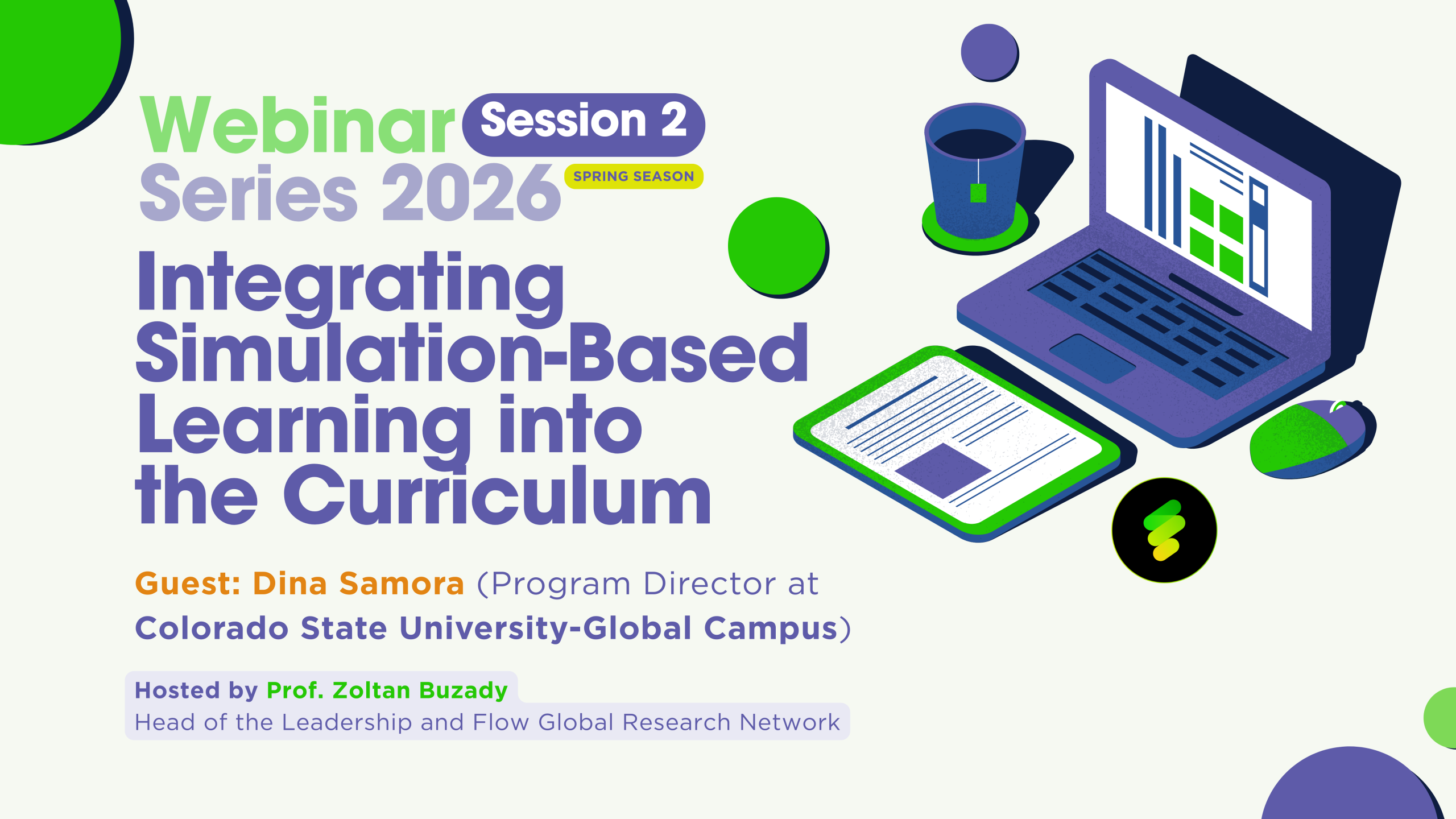
Joined by Dina Samora, Program Director at Colorado State University Global Campus, the discussion offered a grounded, experience-based perspective on what it takes to embed simulations effectively in a curriculum.
Dr. Samora provided an excellent summary of the key elements for integrating interactive online tools (including simulations) into university education. Based on our discussion, we have briefly outlined the three most important prerequisites for successful implementation.
How to Use Simulations in an Academic Class: The Three Pillars of Successful Integration
Start with Learning Goals—Not the Tool
A common mistake in course design is starting with the technology rather than the learning objectives. As Dina emphasized, the most critical question is not which tool to use but what students should learn.
- What skills should they develop?
- What competencies should they strengthen?
Without clear answers, even the most advanced simulation risks becoming a disconnected add-on rather than a meaningful learning experience. Simulation-based learning delivers value only when it directly supports well-defined educational outcomes.
This principle may sound obvious, but in practice, it is often overlooked. Institutions may adopt innovative tools for their novelty or reputation rather than for their alignment with course goals. The result is fragmented learning rather than coherent development.
Technology Must Fit the Institutional Reality
Even when the pedagogical case is strong, technical integration can make or break implementation.
At Colorado State University Global Campus, the expectation is clear: tools must integrate seamlessly with the existing ecosystem. Ideally, students should access third-party platforms with a “one-click” experience—without separate logins or complicated onboarding.
This requirement highlights two critical realities:
- Integration with the Learning Management System (LMS) is essential.
- Data exchange between systems must be secure, reliable, and scalable.
For this reason, the technical team is a central stakeholder in the process—not just a support function. Their early involvement ensures that the chosen solution can be realistically implemented and maintained.
Deep Understanding Enables Meaningful Integration
Adopting a simulation is not just a procurement decision; it is a pedagogical commitment.
Dr. Samora noted that institutions need dedicated resources to fully understand the tool they are integrating. This includes not only how the simulation works but also how it connects to course content, assessments, and the overall learning journey.
Students should never feel like they are “using a tool.” They should feel like they are progressing through a thoughtfully designed experience. This requires:
- Faculty and instructional designers who understand the simulation deeply
- Careful alignment of simulation scenarios with course topics
- Clear connections between in-game decisions and real-world concepts
In other words, success depends on embedding the simulation in the curriculum, not just attaching it.
The Proven Impact of Simulation-Based Learning
The growing adoption of simulation-based learning is not just a trend—it is strongly supported by research. A large-scale meta-analysis published in Review of Educational Research, covering 145 studies and more than 10,000 learners, found that simulation-based learning yields a very large effect size of 0.85 for developing complex skills. This is particularly notable compared with the average educational intervention benchmark of 0.40, suggesting that simulations can deliver more than twice the typical learning impact.
When simulations are implemented with high realism and strong pedagogical alignment, their impact can be even more pronounced. Studies show that high-fidelity simulations can achieve effect sizes above 1.0, placing them among the most powerful tools in modern education.
The Key Takeaway: From Technology to Experience
Perhaps the most important takeaway from the conversation is this: simulation-based learning is not about technology—it is about experience. When done well, tools like FLIGBY become invisible. What remains is a coherent, engaging journey in which students explore, decide, reflect, and grow. That shift—from tool-centric thinking to experience-centric design—is what separates successful implementations from superficial ones.
Research on experiential learning theory (notably the work of David A. Kolb) shows that learning is most effective when learners actively engage, reflect, conceptualize, and apply. Simulations are uniquely positioned to support this full cycle.
As universities continue to explore innovative teaching methods, the insights shared by Dr. Samora offer a clear roadmap. Start with learning goals, respect technical realities, invest in deep understanding, and design for experience.
Only then can simulation-based learning truly deliver on its promise.
By Judit Nuszpl, Head of Program Development